What are Grooved Couplings
A grooved coupling is a mechanical pipe joint that uses a simple but highly effective design to connect pipes. Instead of welding, threading, or flanging, this method uses a housing, a gasket, and a pair of bolts and nuts. The coupling housing has keys that fit into grooves rolled or cut into the pipe ends. When the bolts are tightened, the housing segments secure the pipes, and the elastomer gasket is compressed to create a durable, leak-proof seal. This flame-free system is renowned for its rapid installation, design flexibility, and reliable performance, making it a preferred choice for fire protection, water supply, and various industrial piping systems.
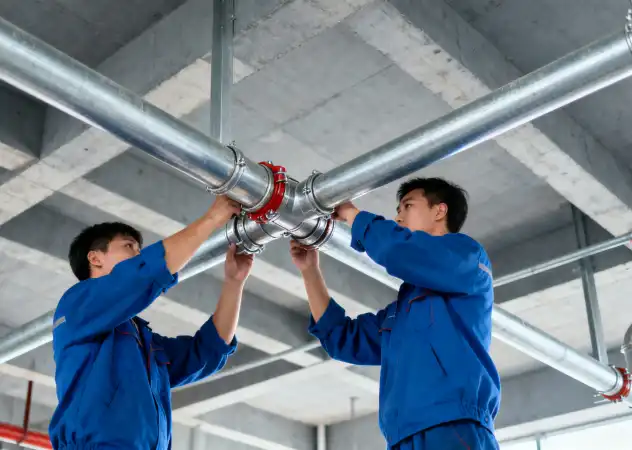
The Mechanics of a Secure Connection
The genius of the grooved pipe coupling lies in its simplicity and strength. Understanding how these components work together reveals why this technology has become a staple in modern piping, offering a superior alternative to traditional joining methods.
How Does a Grooved Coupling Work in Piping Systems?
A grooved coupling creates a seal through a three-part system. First, an elastomeric gasket is stretched over the ends of two grooved pipes. Then, two housing segments are placed over the gasket. The keys on the inside of the housing engage with the grooves on the pipes. Finally, bolts and nuts are tightened, pulling the housing segments together. This action simultaneously clamps the pipes securely and compresses the gasket, creating a unified, leak-proof joint that is strong against internal pressure and external forces. The gasket effectively seals the joint while the housing provides the mechanical strength.
Key Components and Materials of Grooved Couplings
Every grooved pipe coupling consists of three primary parts. The housing is typically made from robust ductile iron or carbon steel, providing high tensile strength to contain pressure. The gasket, responsible for the seal, is an advanced elastomer, with EPDM being common for water applications due to its temperature resistance. The final components are the track bolts and nuts, which are heat-treated for strength and often plated to resist corrosion. These high-quality materials ensure the coupling can withstand demanding system pressures and environmental conditions for a long service life.
Advantages of Grooved Couplings in Industrial Applications
The primary advantage of a coupling grooved system is a dramatic reduction in installation time - often up to five times faster than welding. This directly translates to significant labor cost savings. Since no open flame is required, it also enhances job site safety and eliminates the need for "hot work" permits. Furthermore, these joints can absorb vibration and accommodate thermal expansion and contraction, reducing stress on the entire piping system. Maintenance is also simplified, as the joint can be easily disassembled by removing the two bolts, allowing quick access for system modifications or repairs.
Types of Grooved Couplings and Their Uses
Not all grooved couplings are the same. They are designed with specific characteristics to meet different system requirements, from allowing movement to providing firm support. Choosing the right type is essential for optimizing the performance and longevity of any piping system.
Flexible vs. Rigid Couplings: What's the Difference?
Flexible grooved couplings are engineered to allow a controlled amount of linear, angular, and rotational movement at the joint. This makes them ideal for systems that experience thermal expansion and contraction, seismic activity, or vibration, as they prevent stress from building up in the pipelines. Rigid couplings, in contrast, are designed to create a stiff, non-flexible joint. The housing segments interlock firmly with the pipe grooves, restricting movement and providing a joint that functions similarly to a traditional welded or flanged connection, perfect for long, straight pipe runs.
Common Applications: Fire Protection, HVAC, and More
Grooved fittings are exceptionally versatile. In fire protection systems, their quick installation and UL/FM-approved reliability are critical. Municipal water systems and water treatment facilities depend on their durable, leak-proof performance and corrosion resistance. In commercial buildings, HVAC systems use grooved pipe coupling products for chilled water and heating lines, where their ability to handle temperature changes is a major benefit. Industrial plants also use them for a variety of process piping, thanks to their robust construction and easy maintenance, making them a go-to solution across numerous sectors.
Specialty Couplings for Unique Challenges
Beyond standard flexible and rigid types, the grooved system includes a variety of specialty couplings. Reducing couplings allow for a direct transition between pipes of different diameters without the need for extra fittings, saving space and installation time. Outlet couplings provide a direct, mechanically-bolted branch outlet in a pipe run, which can be installed much faster than welding a traditional outlet. These innovative solutions demonstrate the system's adaptability, offering efficient answers to common and complex piping challenges encountered in the field.
The Installation Advantage: Speed and Simplicity
One of the most celebrated features of the grooved mechanical joining method is its unparalleled installation speed. This efficiency not only accelerates project timelines but also delivers significant economic benefits without compromising the integrity of the connection.
A Step-by-Step Guide to Installing a Grooved Pipe Coupling
Installing a grooved coupling is a straightforward process. First, inspect the pipe ends to ensure they are clean and properly grooved. Next, apply a thin layer of compatible lubricant to the gasket and stretch it over one pipe end. Bring the second pipe against the first, and slide the gasket into position, centering it over both pipe ends. Then, place the two housing segments over the gasket, ensuring the housing keys align with the pipe grooves. Finally, insert the bolts and nuts, tightening them alternately and evenly until there is metal-to-metal contact at the bolt pads.
Comparing Installation Time: Grooved vs. Welded or Flanged
The time savings are substantial when comparing grooved systems to traditional methods. Industry studies and field experience show that installing a grooved coupling can be up to 10 times faster than welding a joint of the same size. Compared to flanged joints, which require careful bolt-hole alignment and multi-pass tightening, grooved systems can be three to four times faster. This speed is a game-changer on large projects, reducing the overall labor budget and allowing subsequent construction trades to start their work sooner.
Tools and Preparation Needed for a Proper Connection
Unlike welding, which requires specialized equipment, power sources, and certified personnel, a grooved joint only requires one simple tool: a socket wrench or an impact wrench. The primary preparation involves ensuring the pipe has a properly formed groove that meets specifications and that the pipe ends are free of dirt and debris. This simplicity eliminates the need for gas tanks, welding machines, and fire watch personnel, making the worksite safer, cleaner, and more efficient. The minimal tool requirement also makes it an ideal method for installations in tight or remote spaces.
Ensuring Longevity and Reliability
A piping system is only as strong as its weakest link. That is why the material quality, protective coatings, and certified performance of grooved couplings are so critical. These factors are the foundation of a reliable system that will last for decades.
The Importance of High-Quality Materials like Ductile Iron
The choice of material is fundamental to a coupling's performance. Ductile iron is the material of choice for most grooved coupling housings due to its unique combination of strength and ductility. It possesses the high tensile strength of steel to handle high internal pressures, but also has the corrosion resistance and vibration-damping properties of cast iron. This makes it exceptionally durable and resistant to damage during shipping, handling, and installation. Using premium ductile iron ensures the coupling can safely and reliably secure the joint for the life of the system.
Protective Coatings: Paint, Epoxy, and Galvanization
To protect against environmental factors, grooved couplings are finished with robust coatings. A standard painted finish is suitable for most indoor environments. For more corrosive conditions, an epoxy coating offers a thicker, more resilient barrier against moisture and chemicals. For the most demanding outdoor or industrial applications, a hot-dip galvanized finish provides superior corrosion protection. This process coats the coupling in a layer of zinc, creating a long-lasting defense against rust and extending the service life of the fitting significantly.
Quality Certifications: Why ISO, UL, and FM Matter?
Third-party certifications provide undeniable proof of quality and performance. An ISO 9001 certification ensures the manufacturer follows a strict, globally recognized quality management system for consistent production. For life-safety systems, UL Listing and FM Approval are paramount. These marks indicate that the coupling has undergone rigorous, independent testing to meet the highest standards for reliability in fire protection applications. When you choose a UL/FM certified coupling, you are choosing a product proven to perform when it matters most.
Conclusion
Grooved couplings represent a significant evolution in pipe joining technology, offering a powerful combination of speed, safety, and reliability. By using a simple yet robust mechanical design, they provide a secure and leak-proof joint that is faster to install than any traditional method. From accommodating movement with flexible designs to providing steadfast support with rigid versions, these components are adaptable to countless applications. Investing in high-quality, certified grooved couplings made from durable materials like ductile iron ensures a long-lasting, low-maintenance, and highly efficient piping system for any project.
FAQs
What is the maximum pressure a grooved coupling can handle?
The pressure rating of a grooved coupling varies depending on its type, size, and the pipe wall thickness. However, standard couplings are commonly rated for pressures up to 300 PSI (20 bar) or higher. For specific applications, especially high-pressure ones, it is essential to consult the manufacturer's technical data sheets to ensure the chosen coupling meets the system's requirements.
Are grooved couplings suitable for underground use?
Yes, grooved couplings can be used in buried applications, provided they have the proper corrosion protection. Couplings with a hot-dip galvanized or fusion-bonded epoxy coating are specifically designed to withstand the harsh conditions of direct burial. It is also recommended to wrap the joint with a protective material to further guard against soil-induced corrosion.
Can you connect a grooved pipe to a flanged pipe?
Yes, this is easily accomplished using a grooved flange adapter. This specialty fitting has a grooved end to connect to the pipe with a standard coupling and a flanged end that can be bolted directly to a flanged valve, pump, or other component.
Your Expert Grooved Coupling Manufacturer | FLA Industrial
With nearly 40 years of manufacturing excellence, FLA Industrial is your trusted global supplier for high-quality grooved couplings. Our ISO 9001-certified factory produces reliable ductile iron fittings that meet CE, UL, and FM standards, ensuring top performance in firefighting and water supply systems. Leveraging our 2,000-ton inventory for immediate shipment and our expertise in creating custom-shaped parts, we deliver standard and non-standard solutions with unmatched speed. Contact our team for expert support and a competitive quote at sales@flaindustrial.com.
References
Victaulic. (2019). Piping and Equipment Installation Handbook.
National Fire Protection Association. (2019). NFPA 13: Standard for the Installation of Sprinkler Systems.
American Water Works Association. (2016). AWWA C606-15: Grooved and Shouldered Joints.
Willis, M. (2017). Grooved vs. Welded: A Look at the Benefits of Mechanical Pipe Joining. Plumbing & Mechanical Magazine.
Anvil International. (2020). Grooved Piping Design & Installation Guide.
Guzzi, R. (2015). The Evolution of Pipe Joining Technology. Reeves Journal: Plumbing, Heating, Cooling.
Send your inquiry now and start your cooperation with our experienced team.